

Press Release on “Randomized Controlled Clinical Study of Electroacupuncture for Tinnitus”
10.26.2026
- Share:
10.26.2026
A multicenter, randomised controlled clinical trial conducted by Pok Oi Hospital –Chinese Medicine Services in collaboration with the School of Chinese Medicine (SCM) at The Chinese University of Hong Kong (CUHK)’ Faculty of Medicine (CU Medicine). Special thanks go to the Sha Tin District Chinese Medicine Clinic cum Training and Research Centre, Yuen Long District Chinese Medicine Clinic cum Training and Research Centre for their participation, as well as the Chinese Medicine Department of Hospital Authority for their support, enabling the trial to be successfully completed. The trial results showed that electroacupuncture (EA) and electroacupuncture combined with warm needling (EAWN) significantly reduce tinnitus loudness and the daily life interference in patients aged 50 to 70. The findings have been published in the international academic journal Complementary Therapies in Medicine.

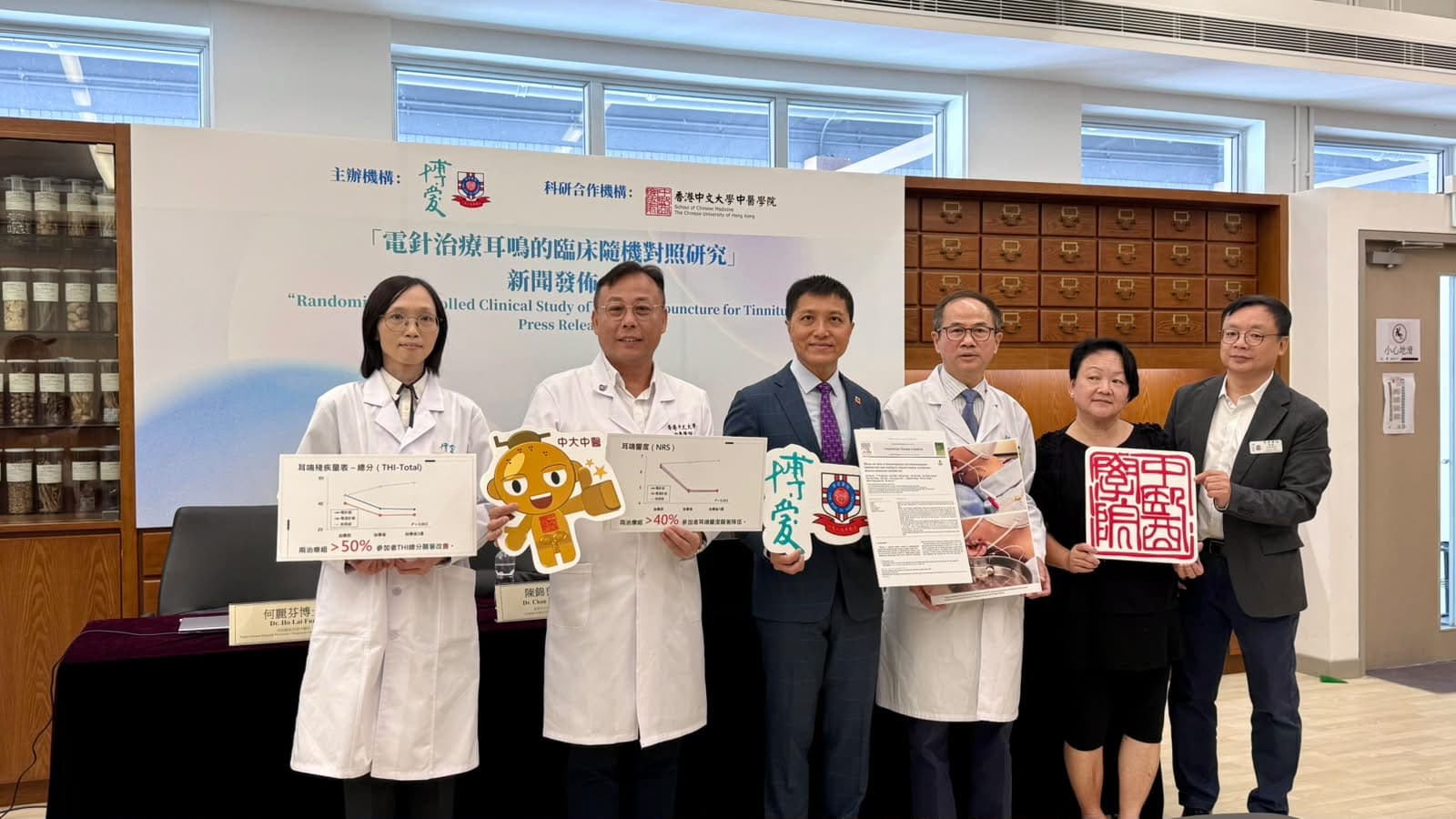
Dr. Chan Kam Leung, Lecturer, School of Chinese Medicine, CUHK (2nd left), Dr. Chan Kwok Ki, MH, JP, Chairman of the Board of Directors of Pok Oi Hospital (3rd left), Senior Chinese Medicine Practitioner of Pok Oi Chinese Medicine Dr. Ho Lai Fun (1st left), and Prof, Guo Yuanqi, Senior Chinese Medicine Consultant of Pok Oi Chinese Medicine and Adjunct Associate Professor, School of Chinese Medicine, CUHK (3rd right), present the findings of the clinical study.
Tinnitus Linked to Blocked Qi and Blood
Tinnitus is a common ear, nose, and throat (ENT) condition, approximately 14.4% of adults have ever experienced tinnitus worldwide. The Chinese University of Hong Kong once estimated based on this data that 200,000 people in Hong Kong suffer from moderate to severe tinnitus. Patients often report hearing cicada-like buzzing, humming, or whistling sounds. Severe cases can trigger sleep disorders and emotional distress, severely disrupting daily life and work. Although conventional interventions—such as cognitive behavioral therapy, tinnitus retraining therapy, and hearing aids—are available, there remains a lack of specific treatments capable of consistently eliminating tinnitus.
The research team noted that traditional Chinese medicine considers acupuncture effective in relieving tinnitus by regulating the flow of qi and blood. Modern mechanistic studies also indicate that acupuncture helps modulate cochlear blood flow and cochlear nucleus activity. Furthermore, it may alleviate tinnitus symptoms by balancing the autonomic nervous system and promoting neuroplasticity in the auditory central nervous system.

Results showed a significant reduction in tinnitus loudness and substantial relief from tinnitus related daily life interference. (Representatives, left to right: Dr. Ho Lai Fun, Senior Chinese Medicine Practitioner of Pok Oi Chinese Medicine , Dr. Chan Kam Leung, Lecturer, School of Chinese Medicine, CUHK, Prof, Guo Yuanqi, Senior Chinese Medicine Consultant of Pok Oi Chinese Medicine and Adjunct Associate Professor, School of Chinese Medicine, CUHK , Dr. Chan Kwok Ki, MH, JP, Chairman of the Board of Directors of Pok Oi Hospital)
Nearly Half of Treatment Group Participants Report Improvements in Tinnitus Loudness and Quality of Life
To evaluate the efficacy and safety of acupuncture therapies, the research team recruited 90 patients aged 50 to 70 suffering from subjective tinnitus for 0.5 to 24 months between December 2022 and April 2024. Participants were randomly assigned in equal numbers (30 per group) to an electroacupuncture (EA) group, an electroacupuncture combined with warm needling (EAWN) group, and a waitlist control group.
Patients in the two treatment groups received a standardized regimen twice weekly for 5 weeks (10 sessions in total). Primary acupoints included Tinggong (SI19) and Yifeng (TE17) on the affected side, along with Baihui (GV20), Yintang (GV24+), bilateral posterior temporal line (the scalp acupuncture line MS11), and Zhongzhu (TE3), and Zusanli (ST36) on the affected side. The waitlist control group received no acupuncture treatment during the study period.
Key findings include:
Significant Reduction in Tinnitus Loudness: At the end of the 5-week treatment, the EA and EAWN groups saw their tinnitus loudness scores decrease significantly by 1.91 points and 1.81 points more than the waitlist group, respectively. During the week 10
Substantial Relief from Daily Life Interference: At weeks 10, 55% of patients in both treatment groups showed clinically significant improvements in Tinnitus Handicap Inventory (THI) 1 total scores. Overall tinnitus severity among patients improved from “moderate” to “mild.”
Comparable Efficacy and High Safety: No serious adverse events occurred throughout the study; only a few patients experienced minor, self-resolving localized pain or bruising at the needle sites. In contrast, tinnitus loudness and distress scores in the untreated waitlist control group gradually worsened over the 10-week observation period.
This study confirms that a twice-weekly, 5-week protocol (10 sessions) of EA or EAWN offers high clinical utility, exceptional safety, and strong patient compliance (exceeding 90% in both treatment groups), serving as a safe and effective complementary treatment option for middle-aged and elderly patients with subjective tinnitus.